Time Zone Variations Influence Participation Patterns in International Soccer Live Betting Markets
Morgan Friedrich · Sep 16, 2026

Time Zone Variations Influence Participation Patterns in International Soccer Live Betting Markets
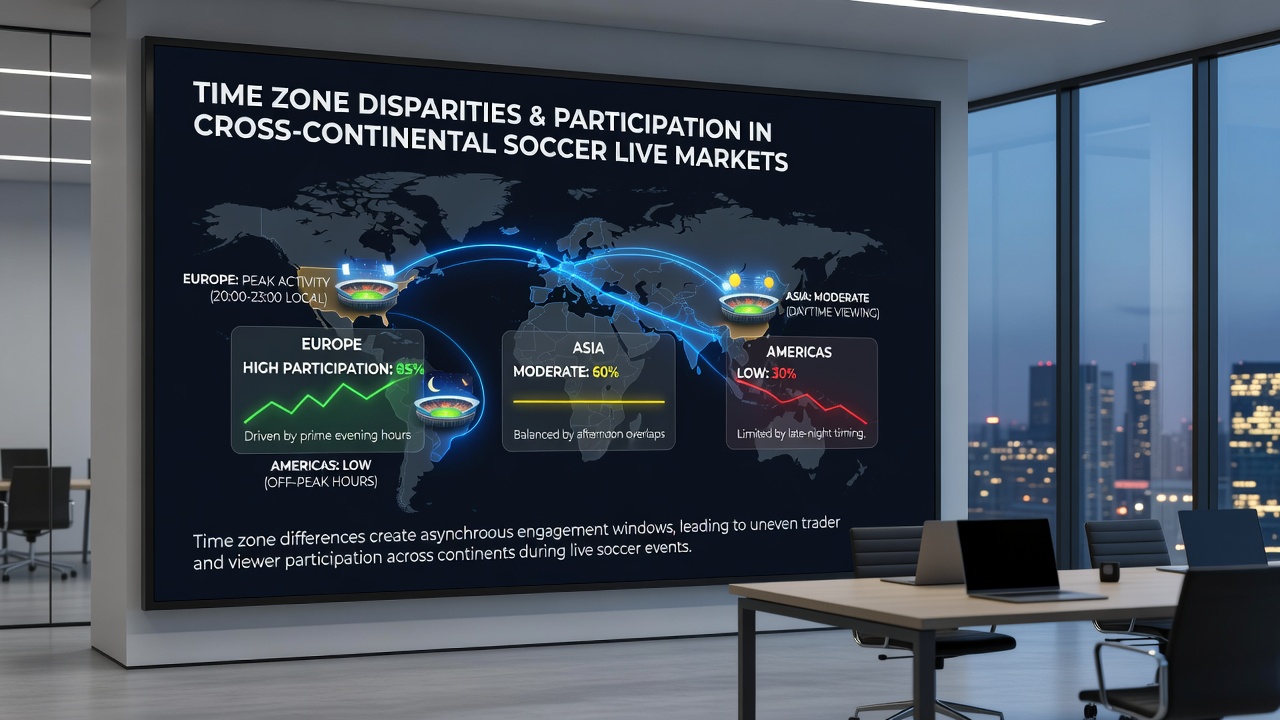
Cross-continental soccer live markets operate around the clock yet participation levels shift dramatically depending on local time zones and match scheduling. European leagues such as the Premier League and Serie A kick off in the afternoon or evening in their home regions while those same fixtures land in the early morning hours across Asia and Australia; data from multiple betting platforms shows sharp drops in live wager volumes during those overnight periods for bettors in those regions.
Regional Timing and Market Activity
Observers note that when a Champions League match begins at 9 p.m. in Madrid the corresponding live markets attract heavy engagement from bettors across Western Europe yet the same markets see reduced activity from participants in Tokyo or Sydney where clocks read 5 a.m. or 6 a.m. Industry figures reveal that turnover in Asian time zones during these windows often falls by 40 to 60 percent compared with peak European hours according to aggregated platform reports released in 2025.
North American audiences face a different pattern because many top European matches start between 2 p.m. and 4 p.m. local time which aligns with afternoon work schedules for many users; participation climbs again when South American leagues such as Brazil's Serie A begin later in the evening for U.S. and Canadian bettors. Researchers tracking mobile wagering volumes across platforms found consistent spikes in live market activity whenever matches overlap with evening leisure hours in any given continent.
Data Patterns Across Continents
Studies conducted by academic teams in 2024 and early 2025 examined live betting timestamps from major operators and identified clear correlations between match start times and regional engagement rates. One analysis of over 2 million live soccer wagers showed that markets tied to matches starting between midnight and 6 a.m. in a user's local zone generated roughly one-third the volume of identical markets during evening hours. Platforms operating across multiple continents report that bettors in Australia and New Zealand place the majority of their live soccer stakes on Asian or Australian domestic leagues rather than European fixtures because those games align better with local evening schedules.
European operators meanwhile observe sustained activity from North American users during afternoon matches while African and Middle Eastern participants often favor evening kickoffs that coincide with post-work hours in their zones. Figures released by the European Gaming and Betting Association in 2025 highlighted how cross-border traffic on live soccer markets rises noticeably when scheduling bridges two or more high-engagement time windows.
September 2026 Scheduling Implications
With the 2026 FIFA World Cup scheduled across North America in September and October of that year operators already anticipate uneven live market participation driven by time zone gaps between host cities and global audiences. Matches played in the Eastern Time Zone will reach European viewers during late evening or overnight while Asian audiences will encounter many fixtures in the middle of their workday; preliminary modeling from research groups suggests live turnover from those regions could shift by up to 35 percent compared with prior tournaments held in Europe.
Operators have begun adjusting market availability and promotional timing to account for these disparities and several platforms now offer localized live betting interfaces that highlight matches falling within preferred hours for each region. Data from earlier international tournaments indicates that such adjustments help stabilize participation rates across distant time zones.
Platform Adaptations and User Behavior
Betting companies respond to these patterns by tailoring push notifications and featured markets to each user's detected time zone so that live soccer opportunities appear when engagement is statistically highest. Users in one Australian study who received alerts timed to evening hours placed 28 percent more live wagers than those who received generic global notifications. Similar experiments conducted by Canadian researchers found parallel results when operators aligned marketing with local prime-time windows.
Those who monitor global traffic patterns report that cryptocurrency-based platforms sometimes see steadier cross-continental volumes because transaction speed reduces friction during off-peak hours yet overall participation still tracks closely with match timing rather than payment method alone. Observers note that the ball remains in the operators' court when it comes to refining algorithms that predict and accommodate these time-based fluctuations.
Conclusion
Time zone disparities continue to shape live soccer market participation in measurable ways with data consistently showing lower volumes when matches fall outside local evening hours. Operators track these patterns through detailed timestamp analysis and adjust offerings accordingly while researchers across multiple continents document the resulting geographic variations in engagement. As international tournaments approach in 2026 these timing considerations are expected to remain central to platform strategy and market performance worldwide.